
Economics tutorials by Samuel L. Baker are licensed under a Creative Commons Attribution-ShareAlike 4.0 International License.
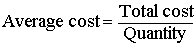
The Average Cost is the Total Cost divided by the rate of output.
This tutorial
Imagine that you have a toy factory.
Your an annual fixed cost is $10000. This fixed cost covers loan interest, utilities, property taxes, etc.
Suppose the marginal cost of producing each toy is $1. This is labor and materials.
If you need it, there is a tutorial that explains marginal cost.
What is the average cost per toy if you make just 1 toy a year?
Assume that you can make any number of toys at the same $1 marginal cost per toy.
What is the average cost per year of producing 2 toys
per year?
It's easy to confuse average cost with marginal cost. Marginal cost
is the cost of adding or subtracting one unit of output.

The average cost includes a portion of the fixed cost, as well as variable cost. The marginal cost includes only variable cost.
Suppose someone asks, "What is the cost of producing a toy?" He or she might want the average cost or he or she might want the marginal cost. You have to guess which from the context of the question.
In the table below, I put the marginal cost between the columns, because it is calculated by comparing two output rates. Average cost goes directly in the columns. Average cost is is calculated from cost information at one output rate. You divide the total cost of that output rate by the amount produced.
Number of Patients per Year:
0 1
2 3 4
5 6 7
8 9
Total Cost:
$ 1000 4500 7500 10000 12000
14500 17500 21000 25000 30000
Marginal Cost: = difference in Total Cost
$ 3500 3000 2500
2000 2500 3000 3500 4000
5000
Average Cost: = Total Cost ÷ Number of
Patients
$ ---- 4500 3750 3333
3000 2900 2917 3000 3125
3333
The average cost of serving 3 patients, for example, is ...
The average cost help you see whether you are breaking even, or making money, or losing money. Try this True or False question:
Suppose that Joan's charges all of its patients the same price.
Then Joan's is making a profit if, and only if, the average cost
is less than the price.
That is true.
That is false.
Let's do a numerical example that shows this. The example also illustrates break even analysis.
Number of Patients:
0 1
2 3 4
5 6 7
8 9
Total Cost:
$ 1000 4500 7500 10000 12000
14500 17500 21000 25000 30000
Total Revenue: = number of patients times the price, $3200
$ 0 3200 6400
9600 12800 16000 19200 22400 25600
28800
This table shows Joan's costs and revenues if patients pay $3200 each.
Joan's breaks even or makes a profit at some output rates,
that is, at some numbers of patients served per year.
What is the lowest output rate at which Joan's
at least breaks even?
What is the highest output rate that is profitable for Joan's?
Leaving space until the above question is answered correctly.
⇑
⇑
⇑
⇑
⇑
⇑
⇑
⇑
⇑
⇑
⇑
⇑
The break even point is the lowest output level at which total revenue exceeds total cost.
You could argue that there are two break-even points for Joan's. Joan's loses money if she signs up too few or too many patients. In practice, selling too few is a way more common problem than selling too many. We therefore define the "break even point" as the minimum you have to do to make your enterprise viable.
By this definition, the break even point for Joan's is 4.
This table shows in boldface the profitable output rates for Joan's if the price is $3200:
Number of Patients per Year:
0 1
2 3 4
5 6 7
8 9
Total Revenue: = number of patients times price patients pay ($3200)
$ 0 3200 6400
9600 12800 16000 19200 22400 25600
28800
Total Cost:
$ 1000 4500 7500 10000 12000
14500 17500 21000 25000 30000
Profit (= Revenue minus Cost)
$-1000 -1300 -1100 -400
800
1500 1700 1400 600
-1200
Average Cost: = Total Cost ÷ Number of
Patients
$ ---- 4500 3750 3333
3000 2900 2917 3000
3125 3333
Average cost less than $3200.
There are two ways to do a break even analysis.
Method 2 requires that all your customers pay the same price. Method 1 is more flexible -- there can be a non-linear relationship between output rate and revenue. In this tutorial, we assume that all customers do pay the same price, so we can talk about "the price" and use either method to determine the break even point.
Let us see what happens if more and more firms enter the market and drive the price down.
Here is the cost table, again:
Number of Patients per Year
0 1
2 3 4
5 6 7
8 9
Total Cost:
$ 1000 4500 7500 10000 12000
14500 17500 21000 25000 30000
Marginal Cost: = difference in Total Cost
$ 3500 3000 2500
2000 2500 3000 3500 4000
5000
Average Cost: = Total Cost ÷ Number of
Patients
$ ---- 4500 3750 3333
3000 2900 2917 3000 3125
3333
Let's start with a high price of $4200.
What is Joan's break even point, based on that price and the costs above?
Where does Joan's average cost bottom out? At what output rate is Joan's average cost minimized?
True or false: A firm should always choose the output level at which
its average cost is the least.
True.
False.
The cost table yet again:
Number of Patients per Year
0 1
2 3 4
5 6 7
8 9
Total Cost:
$ 1000 4500 7500 10000 12000
14500 17500 21000 25000 30000
Marginal Cost: = difference in Total Cost
$ 3500 3000 2500
2000 2500 3000 3500 4000
5000
Average Cost: = Total Cost ÷ Number of
Patients
$ ---- 4500 3750 3333
3000 2900 2917 3000 3125
3333
What is the number of patients that gives Joan's the most profit,
if the price patients pay is $4200?
I am deliberately switching back and forth between marginal cost and average cost, to better bring out what each is good for.
The cost table again:
Number of Patients per Year
0 1
2 3 4
5 6 7
8 9
Total Cost:
$ 1000 4500 7500 10000 12000
14500 17500 21000 25000 30000
Marginal Cost: = difference in Total Cost
$ 3500 3000 2500
2000 2500 3000 3500 4000
5000
Average Cost: = Total Cost ÷ Number of
Patients
$ ---- 4500 3750 3333
3000 2900 2917 3000 3125
3333
Now what is Joan's break even number of patients, after the price has
fallen to $3200?
Leaving space until the above question is answered correctly.
⇑
⇑
⇑
⇑
⇑
⇑
⇑
⇑
⇑
⇑
⇑
⇑
Number of Patients:
0 1
2 3 4
5 6 7
8 9
|-----Profitable range-->?
Total Cost:
$ 1000 4500 7500 10000 12000
14500 17500 21000 25000 30000
Marginal Cost: = difference in Total Cost
$ 3500 3000 2500
2000 2500 3000 3500 4000
5000
Average Cost: = Total Cost ÷ Number of
Patients
$ ---- 4500 3750 3333
3000 2900 2917 3000 3125
3333
What is the top end of the profitable range, the most patients Joan's
can serve and still make a profit, if the price patients pay is $3200?
The profitable output range shrinks as the price falls. When the price
was
$4200, profitable output rates were 2 through 9. As the price falls,
Joan's leeway is reduced.
Number of Patients:
0 1
2 3 4
5 6 7
8 9
Total Cost:
$ 1000 4500 7500 10000 12000
14500 17500 21000 25000 30000
Marginal Cost: = difference in Total Cost
$ 3500 3000 2500
2000 2500 3000 3500 4000
5000
Average Cost: = Total Cost ÷ Number of
Patients
$ ---- 4500 3750 3333
3000 2900 2917 3000 3125
3333
What would be a price for which the break-even or make-profit output rate range would be just 5 to 6 patients per year?
As new firms flood into the home care market, the price patients have to pay will be bid down further and further.
What price is so low that the best Joan's can do is just break even?
Number of Patients:
0 1
2 3 4
5 6 7
8 9
Total Cost:
$ 1000 4500 7500 10000 12000
14500 17500 21000 25000 30000
Marginal Cost: = difference in Total Cost
$ 3500 3000 2500
2000 2500 3000 3500 4000
5000
Average Cost: = Total Cost ÷ Number of
Patients
$ ---- 4500 3750 3333
3000 2900 2917 3000 3125
3333
If competition in the industry drives the price down this low, this will squeeze the profit out of the industry, assuming that Joan's costs are typical.
If the price falls this low, and profits disappear, new firms will stop entering this market, and some established ones may fold.; This will make the supply stop growing and the price stop falling.
In an ideal theoretical competitive market, the freedom to set up a new business firm guarantees that the consumers' demands for products and services will be met at the lowest possible costs and prices.
Those prices will be at (or just above) the minimum level of average cost.
This is called consumer sovereignty.
Below is what Joan's costs might look like now:
Can Joan's now make profit if the price is $2900?
Number of Patients:
0 1
2 3 4
5 6 7
8 9
Total Cost:
$ 2000 5600 8500 10700 12200
14000 16100 18500 21200 24700
Marginal Cost: = difference in Total Cost
$ 3600 2900 2200
1500 1800 2100 2400 2700
3500
Average Cost: = Total Cost ÷ Number of Patients
$ ---- 5600 4250 3567
3050 2800 2683 2643 2650
2744
Can Joan's now make profit if the price is $2900?
How many patients should Joan's serve to maximize profit at the $2900
price?
With the old technology, Joan's treated 5 patients and just broke even, when the price was $2900.
With the new cost-cutting technology, Joan's expands her output rate to 8.
If all the firms in the industry adopt the new technology, so that all the firms have costs just like Joan's, then every firm will try to expand its output just as Joan's did. Which way will the price go?
My analysis assumes that there is price competition in this market. By contrast, Brown, M.L., Kessler, L.G., Reuter, F.G., "Is the Supply of Mammography Machines Outstripping Need and Demand?" Annals of Internal Medicine, October, 1, 1990, 113(7), pp. 547-552, found that prices of screening mammograms stayed high despite a great increase in supply, because there was no price competition. I am assuming a textbook type of perfect competition in the market that Joan's is in.
Suppose, though, that competition doesn't work, and the price stays up at $2900. In that case, the firms will want to treat 8 patients each, but there won't be enough patients to go around. Many will have to settle for fewer than 8 patients. What is Joan's minimum break even output rate?
Number of Patients:
0 1 2 3 4 5 6 7 8 9
Total Cost:
$ 2000 5600 8500 10700 12200 14000 16100 18500 21200 24700
Marginal Cost: = difference in Total Cost
$ 3600 2900 2200 1500 1800 2100 2400 2700 3500
Average Cost: = Total Cost ÷ Number of Patients
$ ---- 5600 4250 3567 3050 2800 2683 2643 2650 2744
That should be plenty on the break even output rate and the profit maximizing output rate! Thanks for participating!
 -->
-->